
From Excel to a platform in 90 days: the real roadmap

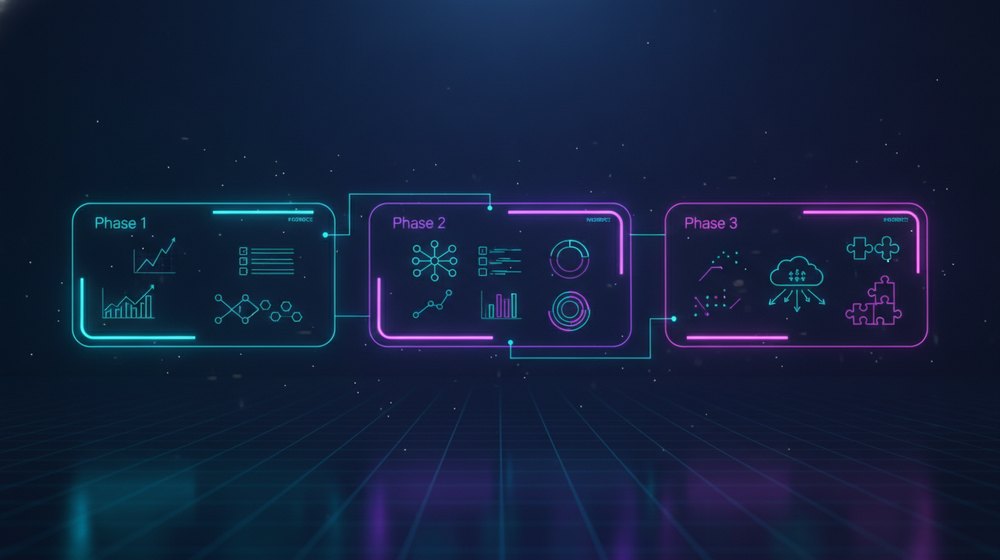
Implementing a custom ERP and leaving spreadsheets behind is possible within a 90-day horizon if it’s done in phases: discovery, prioritization, a first functional module, integration, training and continuous improvement. It’s not magic or a button you flip on; it’s a clear path, with visible deliverables, where your operation never stops.
If your industrial company in the Valley of Mexico runs on Excel and CONTPAQi-style accounting, and you feel the disorder is already costing you money, this is the real roadmap of what the journey from Excel to your own platform looks like.
Why 90 days and why in phases?
Ninety days is a realistic horizon for getting a first system up and running that solves your main pain, not for digitizing every corner of the company at once. That is precisely the mistake that sinks so many projects: wanting everything at the same time, stopping the operation and training everyone all at once.
Working in phases inverts that logic. You start with what hurts most, launch something usable early and build the rest on that foundation, with the team adopting at its own pace. That way the project generates value —and confidence— from the first weeks, instead of asking for faith for a year.
What happens in the first weeks? Discovery and priorities
It all starts by understanding your real operation, not the ideal one. In this phase you document how you work today: how an order comes in, how you quote, how inventory moves, where the data lives and at what point things stop reconciling.
With that map on the table, the next stages are prioritized:
- The main pain first. You identify the process costing you the most money or time today: almost always inventory, quoting or leadership reports.
- What delivers value fast. You choose a narrow scope that can be running soon and prove the return.
- What can wait. Everything that isn’t urgent is left for later phases, so the kickoff doesn’t get bloated.
At the end of this stage you don’t have code yet, but you have something more valuable: clarity on what will be built, in what order and why.
How is the first functional module built?
This is where the project becomes tangible. The first module —the one attacking your main pain— is developed and put in your people’s hands as soon as possible, even with a minimal scope. The idea is that you see and touch something real in weeks, not months.
That first module is refined through use. Your team tests it with real data, points out what’s missing or what doesn’t fit their way of working, and it gets corrected. This back-and-forth is what guarantees the system reflects your operation and not a desktop version of how someone “thinks” your company works.
Meanwhile, the operation continues. The new module coexists with what you already had; nobody switches off Excel overnight. The transition is gradual and controlled.
What happens with my accounting and my other systems?
One of the biggest concerns is what happens with the accounting. The answer is reassuring: it isn’t replaced, it’s integrated. Your new platform connects with your CONTPAQi or AdminPAQ so that invoicing, journal entries and catalogs flow without double entry.
We’re not here to throw out what already works: we’re here to connect your information islands into a single source of truth.
In this phase other pieces you already use are also integrated —your GPS, your key spreadsheets, your customer portal if you have one— so the platform becomes the center of your operation, not one more island. The goal is a single source of truth, where data is captured once and serves everyone.
And after the 90 days? Training and continuous improvement
Toward the end of the journey, training takes center stage. Because the system reflects the processes your team already knows, training is short: people recognize their own flow, now organized and without paper. Adoption accelerates because the system removes work rather than adding it.
Once the 90 days are complete, you don’t have a “finished” project, but a living platform that solves your main pain and a foundation on which to keep growing. Continuous improvement comes into play: modules are added, reports are refined, KPIs for leadership are added and, when it makes sense, artificial intelligence is incorporated to quote, alert or summarize.
And at every moment there’s a principle that doesn’t change: you own your code and your data. You don’t rent a dependency; you build an asset of your own.
This is the real path, with no magic promises or fine print. At Normandia Web we guide industrial companies in the Valley of Mexico through it, in phases, with your accounting integrated and your code in your hands. The first step costs you nothing: a free consultation where we map your operation, identify your main pain and show you what your platform would look like. If you’re ready to leave Excel behind, let’s talk and let’s start there.
Ready to put it to work in your company?
Tell us what’s costing you time, money or control. We’ll help you figure out where to start.
Start your consultation →